

Generation 3 & 4 Explained
The arrival in the market place of the Generation 3 systems, is the most important development in Autogas conversion since the Lambda sensor was used to monitor emissions.
Vehicle manufacturers have developed the 4 stroke engine to levels of cleanness and performance only dreamed of a few years ago. From the start of 2001 all vehicles on the road must have engines that comply with a standard called Euro 3. In addition legislation has been passed in the European Parliament for a method of continuously monitoring the exhaust gas emissions. This system is called E.O.B.D. It stands for European On Board Diagnosis. If your car has been registered since the start of that year it has it. One of the aims of this equipment is to monitor the exhaust gases after they have been through the catalytic converter to ensure that they are clean enough. If the emissions are incorrect or another fault is found a warning light will flag up on the dash to telling the driver they have a problem. You must then have the fault rectified immediately. If you are subsequently stopped by one of the enforcement agencies, they are in theory able to interrogate your on board computer and find out how long the fault has been there. It will not be possible to tell them that it came on ten minutes before if it didn't. Large fines, and other terrible punishments have been promised (flogging, ritual dis-embowling etc) to any transgressors.
The effect this has on any Autogas conversion is that it must meet the emissions required and work with the cars computer to ensure the light stays off. To do this the system used must be extremely sophisticated. Enter Generation 3 equipment !!
By fitting gas injectors close to the inlet valves the problem of having an explosive gas mix in the manifold is almost completely eradicated, meaning that back fire problems are eliminated. The fact that the gas inlet is much closer to the engine than on the previous generations means that the engine responds much more quickly, and as the fuel is a gas the combustion is more complete than with petrol.
The description that follows is as basic as I can make it, but I have had to assume that you, the reader possesses some mechanical knowledge. However if it doesn't make sense contact me and all will be revealed.
The back end kit is identical to earlier systems, and indeed the vaporizer under the bonnet is very similar apart from being non-adjustable and having a vacuum pipe running between it and the inlet manifold to ensure that the correct pressure differential is maintained in all circumstances.
The gas flows from the vaporizer to the distribution unit where the volume of gas injected into the inlet manifold is controlled. Each injector receives a signal via the main vehicle computer and the dedicated Autogas ECU so that the correct amount of gas is injected at precisely the right time.
Because the e.c.u. is much more sophisticated than on Generation 2 systems it is possible to control the fuelling more accurately than would have been thought possible only a few years ago. This means that the vehicle should have virtually no discernable power loss in normal circumstances, and fuel consumption more comparable to running on petrol. The environmental benefits being an even greater reduction in pollution of our atmosphere.
The vehicle defaults to petrol on start up, but automatically changes to gas when the engine is revved and the temperature of the vaporizer exceeds 30 degrees C. When the vehicle runs low on gas the e.c.u. detects that the air/fuel mixture is too lean and automatically switches back to petrol.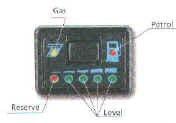
Inside the vehicle the only tell tale sign is a small combined fuel gauge and switch, which is mounted discreetly in the dashboard area. This is identical to the earlier Tartarini systems and unfortunately the fuel gauge is not exactly accurate. To be honest the things about as much use as a chocolate fire guard. However as the rest of the system is superbly engineered, it is a minor problem.
Although the 3rd generation systems were very good, they had one draw back that sometimes caused running problems. This drawback was that they injected fuel in one hit whereas modern engines normally inject fuel sequentially. The SGI system (Sequential Gas Injection) is 4th Generation and works with the vehicles own computer to calculate the amount of fuel required and when to inject it. The result is that the engine runs smoother and there is a greatly reduced risk that an engine fault light may come on. A typical 4 cylinder non-turbo application will cost around £1750 plus vat. Six and eight cylinder vehicles will be more. The pay back being the improved economy.
In addition a whole range of vehicles which in the past could not be converted without serious problems are now able to be taken on.
If you would like more information please feel free to contact us. We are happy to advise.