
|
Air Conditioning Explained
If you just want to find out what we can do, and how much it will cost click here Air conditioning systems have been standard fittings in American cars since the early 1960s. Their big V8 engines easily coped with the extra demand placed on them by the equipment needed to cool down four large people and a pile of beers. In this country it has taken just a bit longer…. Although fitted to some luxury cars for over 40 years, it is only since the mid 1980s that air conditioned cars hit the volume manufacturers. Volvo were among the first, closely followed by Peugeot, and over the next few years all the rest climbed on the band wagon. Much more recently the air conditioning system has been integrated into a network controlled by the vehicles main computer. This is known as a Control Area Network (CAN). To learn more about CAN systems look in "Teccie Talk".
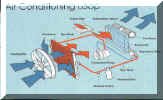
How the system works If you compress a gas it becomes hot, but when you let it expand again it cools down. If you turn a gas into a liquid, and then allow it to turn back into a gas the effect is multiplied. The main components of all systems are as follows. The gas is drawn into the compressor, and then compressed by a number of pistons. The compressed gas then goes through a large radiator normally behind the normal cooling rad, where the gas is cooled. This piece of equipment is called the condenser because it condenses the gas (turns it from a gas to a liquid.) The liquid gas now moves into the car, and is squirted through a jet into another radiator. The gas evaporates and cools down. This radiator is called the evaporator for obvious reasons. Basically that is all there is to it. Provided the system doesn’t develop a leak, the gas will continue this cycle, almost ad-infinitum. Everything else in the system is designed to control temperature or to ensure a longer life for the equipment. Gas A number of gases will work very well, however only two have been deemed as suitable for use on motor vehicles. They rejoice in the imaginative names of R12 and R134A. R12 is no longer produced, and since the 1st of January 2001 it has been illegal for us to use it in air con systems. This is not a problem until the system needs some maintenance, at that stage the customer has the choice of either having the vehicle converted to use R134a, or opening the window. All cars manufactured since 1994 have used R134A. The reason for this is that R12 is a CFC which means that it does not break down in the atmosphere, and contributes to the destruction of the ozone layer. Indeed it is illegal to vent this gas , the maximum fine being £20,000. It is unfortunately the case that the two gases are incompatible, and where R12 was fairly benign to rubber seals etc, R134a has a tendency to destroy them, and certain types of hose. So changing from one to the other can be a bit of a problem. The process of converting a system to run on R134a is known as "retro-fitting". Retro-fitting This involves removing all trace of the old gas, along with any oil in the system. (Because mineral oil will react with R134a) All o-rings are changed, and the system flushed. The access valves are also replaced with ones designed for R134a. along with the drier. Including vat and parts the cost of this work will be around £250.00. You should remember that if any problems are encountered with the system, then the cost will increase. This is the sting in the tail, because until there is gas in the system it cannot be tested. To learn more about retro-fitting your air con system please click here What goes wrong with Air con Systems ? In short - they leak, yes there are other problems, but they pale into insignificance compared to leaks. Even without apparent leakage the gas will eventually leach out of the system causing the owner to have a re-gas every few years. But leaks are difficult. Big ones that you can see or hear are nice and easy to sort out, it’s the little ones that leak out over a number of weeks or even months that really cause problems. The gas is colourless, odourless, and leaves no trace apart from an oil mark on occasions. The only way to find them is to introduce gas into the system and check it. We use a number of different methods to locate leaks from soapy water to an ultrasonic listening device but nothing is foolproof, because even with sophisticated detection equipment you can still miss them. Because of this we recommend that a leak trace fluid is added with the gas. This glows yellow under an ultra violet lamp, so if the leak is as little as a drip a day, we will find it. Leaks also cause other problems. When the gas leaks out, air leaks in, and along with it comes moisture. The remaining gas tends to react with any water vapour, and cause sludge, and worse still making acids which then attack the equipment. To minimise this problem all air conditioning systems have a drying canister included in the line. These are filled with a hygroscopic material such as silica gel which absorbs any moisture out of the passing gas. These dryers should be replaced whenever the system is opened to the air. How much moisture is acceptable? The answer is really none. However in reality is it almost impossible to get the system totally dry. Concentrations as low as 20 parts per million can cause damage. If you bear in mind that a drop of water in a system that takes about 1.3 kg of refrigerant equates to about 40 ppm. (twice the maximum that the system can deal with.) then it is easy to understand why an extended vacuum needs to be pulled in order to boil off any moisture. The greater the vacuum the lower the boiling point of any water within the system.
We offer a number of options to our customers because we understand that one size does not fit all. For more details about the service options offered please click here
|
* Click on the thumbnail to see just some of the equipment we use to repair air con systems * Most manufacturers recommend that your air conditioning system is serviced every year. * Click on the other thumbnail to look at a basic system. * Your air con system should be used all year round to prevent failure. * The evaporator can become a breeding ground for bacteria and fungus. It should be chemically cleaned annually. * Using air con will increase your vehicles fuel consumption but reduce your need for deodorant. * Since 2001 it has been illegal to use R12 gas in air con systems as it damages the Ozone layer should it leak. * In 1984 the years best selling song Relax by 'Frankie Goes To Hollywood' was played for several weeks by Radio 1, until DJ Mike Read discovered that it was about Gay sex- Bummer! * Using the air conditioning system to demist the screen works because cold air has a lower dew point than warm and is therefore dryer. * When your climate control is set to hot the air is heated after it has been passed over the evaporator and cooled. * The exception to this is when you select economy which turns off the air con altogether *
|